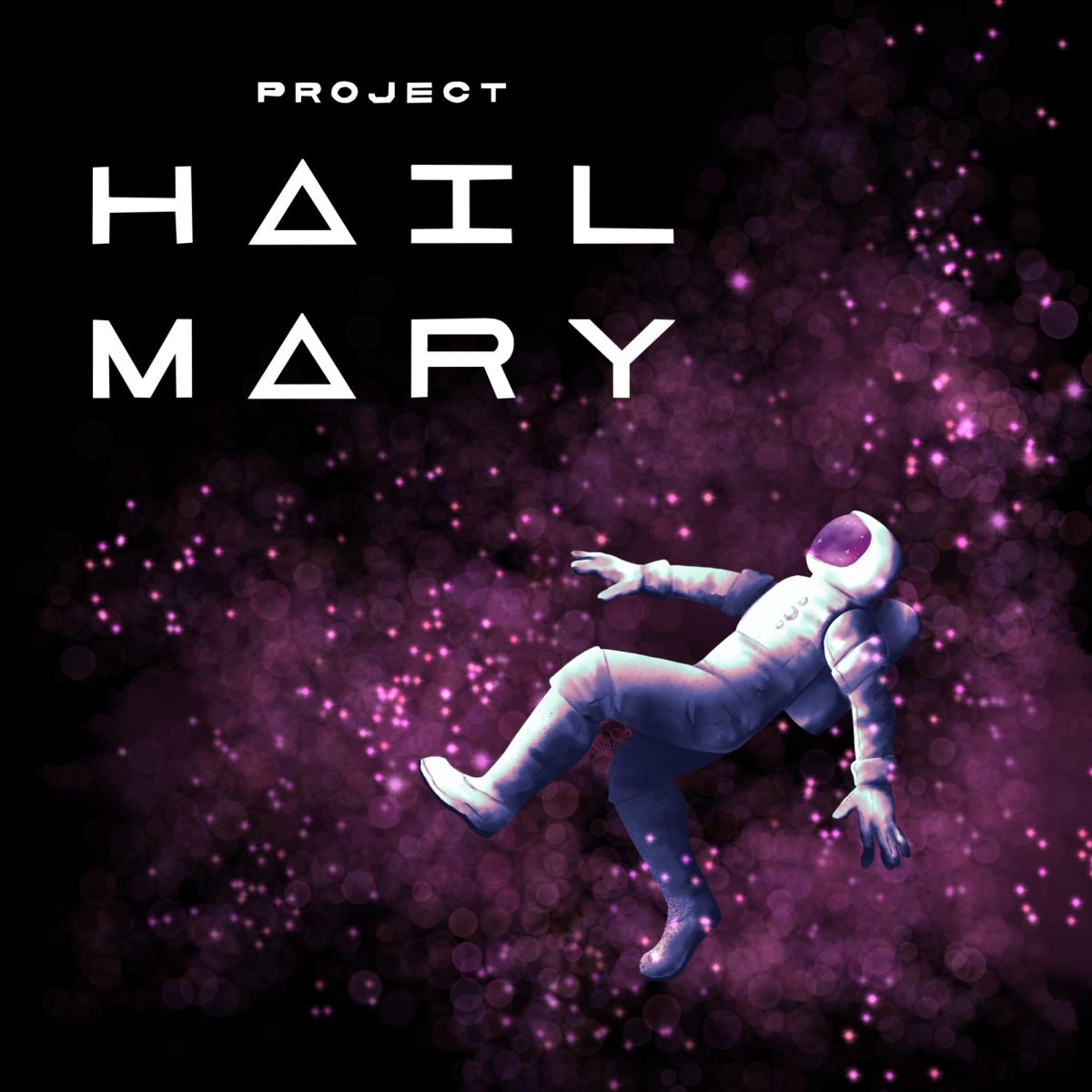
With hundreds of billions of unexplored and undiscovered solar systems, scientists have long speculated about the existence of other lifeforms in outer space. Authors and filmmakers alike have tackled the topics of space travel and alien life. Just recently, “Project Hail Mary” was released to theaters. Is this just another space movie, or is there something unique about this particular story?
According to viewers, “Project Hail Mary” is something special. Within only two weeks of its release date, the movie became Amazon MGM Studios’ highest grossing film of all time. Based on the bestselling novel by science fiction author Andy Weir, “Project Hail Mary” follows Dr. Ryland Grace’s mission to save Earth from an alien parasite, called Astrophage, that is eating away the sun’s energy. The movie begins when Grace wakes up on a spaceship light-years away from Earth to find his memories gone and his crewmates dead.
As Grace slowly regains his memories, he seeks a way to save Earth by observing the Tau Ceti solar system, which contains the only star unaffected by Astrophage. Little does he know that he will make an unlikely ally — an intelligent, entertaining alien named Rocky who is trying to save his own planet. The two face many challenges and emotional sacrifices as they develop a close friendship.
Like many other eager viewers, I grabbed a copy of Weir’s novel to read in preparation for the movie, and I was pleasantly surprised by how close to the book the film adaptation was. Book-to-movie adaptations have a reputation for taking too many creative liberties, but “Project Hail Mary” did a great job sticking to the original plot, even keeping smaller details such as the beanbags Grace used in his middle school science classroom.
However, the movie was created in a way that would have made it much harder to understand if you had not read the book — or at least had some semblance of the plot and characters — beforehand. Weir does an excellent job explaining the science behind everything in his novel, detailing Grace’s thought processes and experiments. The way the ship works as well as the many problems the crew encounters while planning the mission and attempting to extend Earth’s lifetime are very detailed, and it is clear Weir completed a lot of research to get the facts right.
Unfortunately, I found the movie to be sadly lacking in some of these areas. While this might serve as a positive aspect for those who do not want to get bogged down in complicated scientific talk, I thought it removed a lot of necessary information, making the mission seem simpler than Weir portrayed it. For example, the scientists and engineers had to figure out how to work scientific equipment with no gravity, and though they discuss using a centrifuge in the movie, it was not explained to the full extent it was in the book.
While some parts were condensed or removed, there were others that seemed unnecessarily drawn out. I would not say I was completely bored at any part of the movie, but there were definitely scenes that could have been shortened or replaced with information to provide more understanding.
Similar to the book, the movie jumped back and forth between when Grace was on the ship and when he was on Earth before the mission. Though it was a bit confusing at parts, I ultimately really enjoyed this aspect of the movie. I think this timeline was a better choice than having everything occur chronologically because it made the plot more interesting, and, as Grace wakes up with amnesia, it was fun to learn pieces of information along with him as his memories returned.
Another element the movie captured really well was Weir’s witty writing style. Though you would not expect a science fiction story such as this to be funny, I found it to be humorous and highly entertaining. Both Grace’s and Rocky’s personalities were portrayed well, and there were plenty of times I laughed out loud from their random jokes and hilarious interactions.
One unique aspect of this film was the way in which Rocky, the lovable alien Grace meets on his mission, was created. In a world of digital technology, CGI and artificial intelligence, you would expect Rocky to be just another computer-generated character. However, the majority of the filming was actually done with an elaborate puppet controlled by James Ortiz, which is a unique method that I found to be interesting and impressive.
There are so many factors that go into making a good movie, and I thought these aspects came together perfectly in “Project Hail Mary” to present a suspenseful, emotional story. The movie was very well-cast, especially with Ryan Gosling portraying Grace. Gosling really embodied Grace’s personality and humor, creating a character that was both likable and realistic. Sandra Hüller, who plays Head of the Petrova Taskforce Eva Stratt, also did an excellent job, accurately representing Stratt’s personality and mentality as the character makes tough decisions throughout the movie.
Whether the camera was trained on the beauty of outer space and the planets or slowly rotating to represent the centrifugal force of the ship, I found the film design to be cool and entertaining. The soundtrack, composed by Daniel Pemberton, also perfectly encapsulated the tension, emotion and intrigue of the plot, capturing everything from the funny moments between Grace and Rocky to their heartbreaking sacrifices.
Ultimately, “Project Hail Mary” was a touching story about friendship and sacrifice, filled with both suspense and humor. Though the movie lacked detailed explanations, struggled at times with pacing and relied on knowledge of the book for full appreciation, aspects such as the casting, soundtrack and humor perfectly represented Weir’s masterpiece of a novel, definitely making “Project Hail Mary” worth the watch.