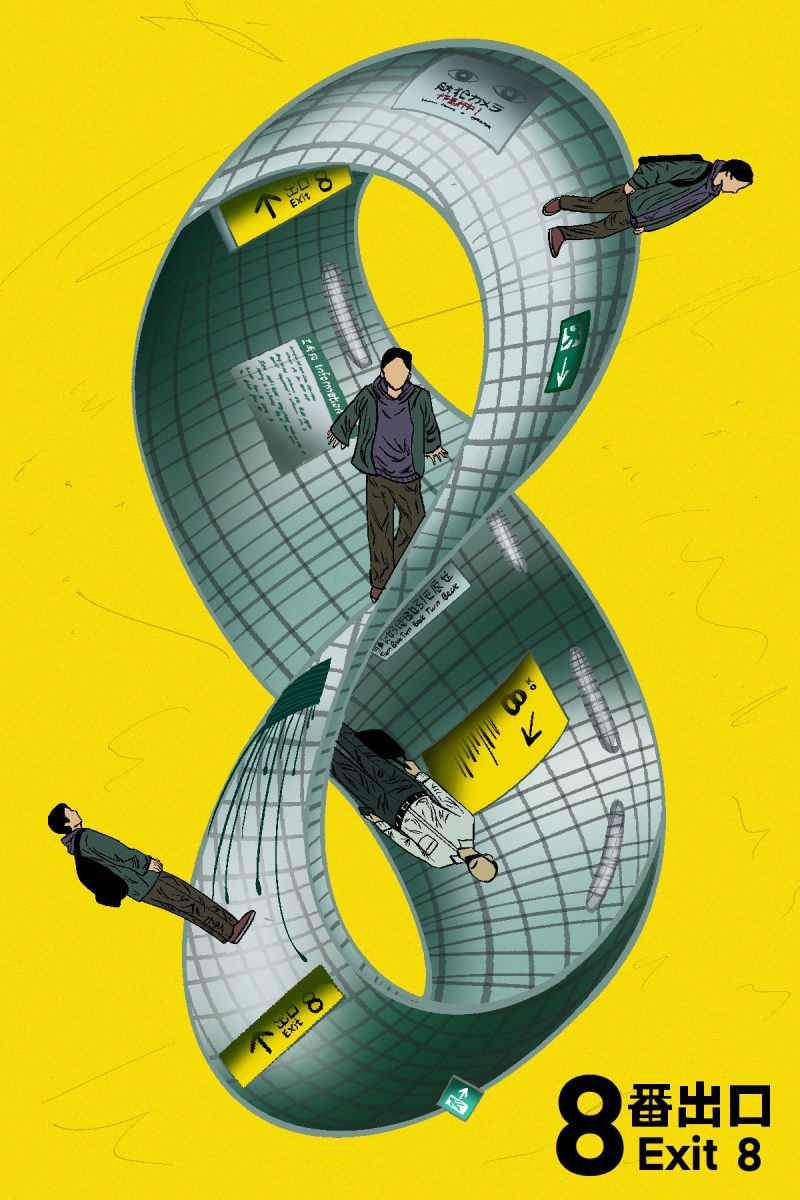
On April 10, “Exit 8” officially released to theaters in America and is the movie adaptation of the horror video game of the same name. It follows the story of The Lost Man, who finds himself lost from the real world subway to a repeating subway loop called Exit 8. With his ex-girlfriend and the decision to keep their baby in mind, The Lost Man’s goal is to find his way back by navigating through each level, continuing through the maze if no anomalies are spotted and turning back if one is. If he fails to notice the differences between each level, he restarts back to Exit 0. Throughout the movie, The Lost Man meets other characters like The Walking Man and The Boy, who are facing their own personal struggles that are reflected in Exit 8’s anomalies.
The most unique thing about “Exit 8” was the unexpectedness of everything: from the scenery, the characters, the plot twists and the anomalies, it is very difficult to predict what will happen next, which is what makes a great movie. The suspense of the slow paced film keeps you on the edge of your seat, and trying to prepare yourself for a jumpscare, as small as an abnormal eye twitch, keeps you guessing whether the character will identify the same things you are seeing. Also, the simplistic soundtrack, from a subtle beep to a sudden distorted repetitive bass, was all the movie needed to compliment the subtle differences.
There is a lack of dialogue in “Exit 8,” which is actually a good thing. Even though the movie is fully in Japanese with English subtitles, the less you heard, the more you paid attention to the visuals. It also added so much more suspense to certain situations when you could not hear anything but a character breathing, a bag ruffling or normal footsteps. If you were to hear intense music, you could better prepare yourself for a jumpscare, so the lack of audio cues to the horror of the unknown is what made “Exit 8” immensely intriguing. When conversational dialogue was present, its main purpose was to give more backstory to the characters, helping the audience to understand their individual motivations as well as give the audience a valid reason to care for each character, which is very important.
The camera always follows the main character, which means we see his facial expressions first before seeing what he is looking at. The camera never strays away from the focal character of the scene, as we are experiencing his observations at the exact same time, so we as an audience are unable to know what the problem is before the character. Our point of view switches with multiple central characters, from The Lost Man to The Boy, especially being in first person as The Lost Man at the beginning of the movie. This visual choice additionally makes the subway seem much more liminal spaced, as the audience feels enclosed and trapped in Exit 8 with The Lost Man, which as a result makes us experience the lack of comfort and space in each level.
Connections between scenes from the movie’s version of reality to the distorted reality of Exit 8 replay the guilt of different characters’ lives. For The Lost Man, his main anomaly of hearing crying babies relates back to his life at home, where he is confronted with the duty of being a father. His hesitation to help a random stranger’s baby in the subway makes him question his role as a potential parent, and the guilt from this difficult decision is reminded in Exit 8’s anomaly. Similarly, it is inferred that The Walking Man works daily, as shown by his work clothes and briefcase. His anomaly consistently reminds him that every day is a depressing constant cycle, repeating the phrase “How sad!” over and over again. This represents the guilt The Walking Man feels with being unable to break out of his monotonous daily routine of working every day.
“Exit 8” proves that you do not need extreme gore or a terrifying image to be considered a horror movie. “Exit 8” uses very subtle small changes in the scenery that make you frantically anticipate what will happen next. From a room simply turning from white to yellow or a doorknob shifting its place over time, these tiny differences not only scare the viewer into thinking the character is “cooked,” but they also allow them to pay more attention to the specific details of the subway. This allows the viewer to immerse themselves into the set and join The Lost Man in counting what has stayed the same and what has changed. When you find something before the character does, like watching all of the posters’ eyes look towards The Lost Man, it adds to your own personal experience of suspense waiting for the character to notice themselves. In contrast, when the character finds something before you do, like noticing another human in Exit 8 is actually an anomaly, it only makes you more interested in catching details than before.
As a result, “Exit 8” does a phenomenal job of thrilling the audience in the most simplistic ways possible; being unpredictable, drastically changing expectations and making sure the audience cannot predict what will happen add to the horror aspect of the movie. While it can be difficult at times to understand every single scene without the video game’s context, the originality of “Exit 8”’s approach to horror through the straightforward fear of the unknown is what successfully differentiates “Exit 8” from the horror movies of today.