The current government shutdown is now the longest in United States history. This government shutdown has resulted in multiple missing paychecks for federal workers, airports having fewer workers come in each day and the Supplemental Nutrition Assistance Program (SNAP) benefits being cut for 42 million citizens.
In order for the government to reopen, Congress must pass either the appropriation bills or a continuing resolution (CR). The current plan on the floor is a CR, which passed The House of Representatives. The House of Representatives has been on a recess since Sept. 19 after passing this CR. Although this plan passed The House, it has failed to pass in the Senate 14 times.
However, this CR is set to expire on Nov. 21. The current CR is no longer a feasible option due to how soon the government would shut down again, leaving Congress with two options: Change the expiration date on the current CR or come up with a new plan. Both of these require The House of Representatives to come back into session. They are set to be back in session after 49 days at 2 p.m on Nov. 7.
Airports are experiencing security wait lines up to three hours. 2,100 flights were delayed on Wednesday. Thousands of aviation workers are forced to make the decision of showing up to work without pay, or finding second jobs to feed their families. On Wednesday night, the Federal Aviation Administration announced that 10 percent of air traffic will be cut from major airports if there is no resolution to the government shutdown as of Friday morning. On Thursday, the FAA released the list of 40 airports that will be impacted by that 10 percent reduction, which included Chicago’s O’Hare and Midway airports.
As delays persist and call-offs increase, the administration has stated it is not safe to continue to function as they are.
As for SNAP assistance, the solution to the lapse in benefits is unclear. Originally, the Trump administration had claimed that no SNAP benefits would go out on Nov. 1. However, multiple judges ruled this unconstitutional as the Department of Agriculture had a contingency fund. This fund was worth 4.65 billion dollars, and is meant to be used in emergencies. Typically, SNAP benefits add up to eight billion a month. Due to the contingency fund being less than that, individuals on SNAP will receive, on average, about 65% of what they typically receive.
On Thursday, a federal judge ruled that full SNAP benefits must go out on Friday, Nov. 7, rather than half. In response to the ruling, the Trump administration filed an appeal to the decision rather than complying with it, claiming that there isn’t enough money to fund full benefits due to the shutdown.
It is uncertain whether Americans can expect full or partial benefits for this month. Regardless, there is an expected delay in delivering that assistance. Before the Thursday ruling, Agriculture Secretary Brooke Rollins told Americans in an X post that it could take weeks to distribute the partial SNAP benefits. This is because different states have different systems, some being older. Although the funding is provided at the federal level, funds are distributed at the state level. Benefits are projected to take weeks, possibly months to reach recipients.
In response to this disruption to SNAP benefits, food pantries and other volunteer organizations across the US are working extra hard to provide food to those who rely on government food assistance. This includes organizations in St. Charles and in other surrounding communities.
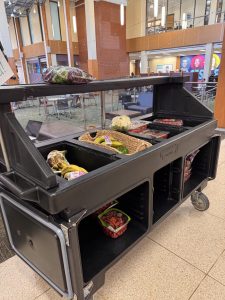
At Elgin Community College, the Spartan Pantry provides snacks and full meals for those in need. The pantry is open to students and community members Monday through Thursday from 10 a.m. to 4 p.m.
“I love the Spartan Pantry. We are open to literally everyone. There is no requirement to log in, if you need something, you can go there if you need something,” said Laci VerCande, chair of documentation for the Spartan Pantry. “We have a lot of snacks, or we have full meals for people who need meals. It is literally open for everyone.”
The pantry recognizes the importance of their services amidst the SNAP benefit interruption.
“We’re advertising our feed the need drive a lot more, and we’re working with a couple other food pantries and organizations like Food for Greater Elgin, and a veteran service to get our food out more to people who are afraid to come into a food pantry, because of the stigma surrounding it,” said VerCande.
The St. Charles Public Library’s community cabinet is another local resource for food assistance. The cabinet, born from the collaboration between East student Aidan Miller and Library Adult Service Manager Amy Vidlak Girmscheid, supplies food to those in need of it.
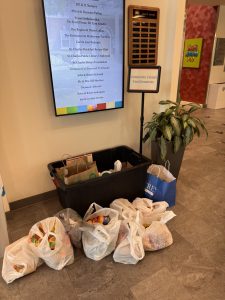
“Most food banks are only open during the day and recipients must qualify for assistance, the library’s community cabinet is open to anyone in need no questions asked,” said Girmscheid. “Plus we provide evening and weekend access to food.”
To keep the cabinet stocked, local organizations will sponsor the cabinet. Last week, D303’s elementary, middle, and high schools participated in a food drive that contributed to the cabinet’s supply.
“Some organizations host food drives and others donate money and we purchase items to keep the cabinet stocked,” said Girmscheid. “We also have a collection bin in the lobby where anyone can donate items.”
In the face of a disruption to SNAP benefits, Girmscheid emphasizes the importance of community resources like the library’s cabinet and staying compassionate for those who are in need.
“Yesterday, while stocking the cabinet I had two community members approach me almost in tears expressing their appreciation. We never know what people are going through,” said Girmscheid. “We need to support each other. To make change it starts at the local level. We need to look out for each other and lift each other up.”