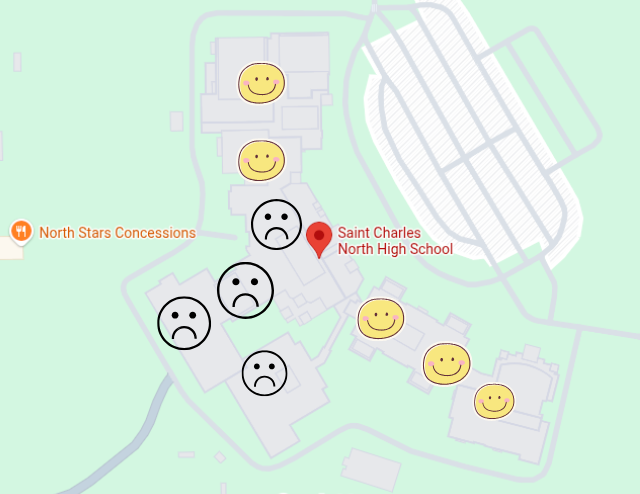
When students first enter North, there may be a few things that stand out to them: the crowded hallways, the sudden presence of blue everywhere and the slow Wi-Fi. It is a common complaint here at North as emails get continually refreshed, text messages are not sent and Chromebooks keep lagging.
This is not just something students would prefer not to happen. The speed of North’s Wi-Fi affects many aspects of our daily lives, including our education. If the Wi-Fi is down, that means that teachers have to adjust their lesson plans, which makes learning less efficient and makes it harder for students to do their work.
“[My student’s] Chromebook died, and then it was really hard for him. He was taking a test in a class, and then it was really hard for him to get back on the Wi-Fi or to get connected again,” said Katherine McCleary, English teacher, instructional support coach and Peer Leadership sponsor.
However, McCleary acknowledges that the WiFi isn’t always the issue. as sometimes, the device is the problem.
“I would choose new devices as a priority over upgrading Wi Fi because I think a lot of times when people have issues with Wi-Fi, it’s not so much the Wi-Fi, it’s the device,” said McCleary.
There may also be another reason students have Wi-Fi issues more than teachers do. The teachers and other staff at North run on a different Wi-Fi than the students. Students run on one of two connections, either the normal or fast one. Undoubtedly, thousands of students on the same network will definitely cause problems.
Additionally, the Wi-Fi affects students’ safety. Those who cannot drive yet rely on the Wi-Fi to text their parents or friends when to pick them up after school. Also, it may be difficult to see texts from friends and family, which can raise a false alarm when parents get worried about why their child is not responding.
“One time, I stayed after school for a club because I had not received the email about the cancelling of the club meeting. I ended up having to wait out in the cold for my parents to arrive,” said freshman Sienna Belleville.
However, not all hope is lost. Depending on where you are in the building, the Wi-Fi signal could be stronger and might allow functions like texting to happen.
“If you’re in the center of the school, it’s tougher than if you’re in more [of] the outer parts of the school, like the gym or the 200s classrooms, or the 100s classrooms,” said McCleary.
Whether we get updated devices or stronger Wi-Fi, something needs to be done about the challenges students face at North. It has become more than an annoying issue: It affects our safety and education, two things North values very highly.
“The school’s Wi-Fi has proven to sometimes impact our safety as students,” said Belleville. “Either the Wi-Fi can become more reliable, or the Wi-Fi connection can equally work as well in a phone as a computer.”