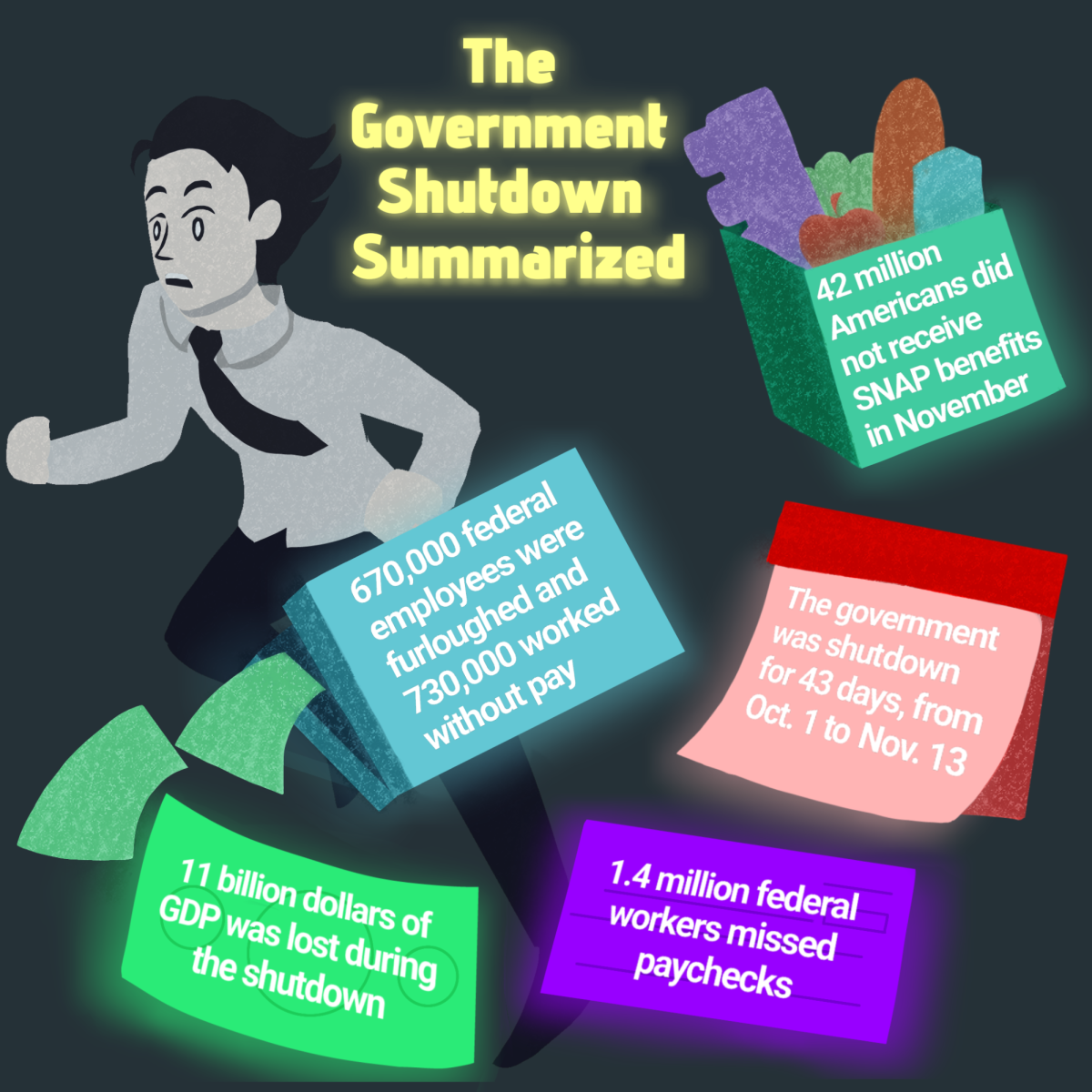
From Oct. 1 to Nov. 13, the U.S. government was shut down. Lasting a total of 43 days, this was the longest government shutdown in U.S. history. Government shutdowns occur when Congress fails to pass around 12 appropriations bills that determine funding for the government. If these bills are not passed by the end of the fiscal year, which runs from Oct. 1 until Sept. 30, then the government shuts down. There are two ways to end the shutdown, either the appropriation bills get passed, or Congress can pass a Continuing Resolution, also known as a CR. Congress opted for the second, and passed a CR on Nov. 12. This CR gives Congress until Jan. 30 to pass the appropriation bills. If they fail to pass the bills again, then the government will shut down again.
Throughout this shutdown, many groups were affected. One of the first of these groups was federal workers. According to CBS, 670,000 federal employees were furloughed, while roughly 730,000 worked without pay during the shutdown. During the shutdown, all 1.4 million included in both of these groups missed full paychecks. After the CR passed, these workers are entitled to backpay. However, it is not clear if all of these individuals have received back pay yet, as some received theirs as late as Nov. 29, according to The Federal News Network.
The Supplemental Nutrition Assistance Program, more commonly known as SNAP, did not have enough funding to provide all of its recipients during the shutdown. SNAP functions through cards issued to recipients, which are refilled monthly. On Nov. 1, the government shutdown prevented SNAP from issuing recipients their allowances in full, resulting in around 42 million Americans not receiving benefits.
The National Park Service temporarily suspended half of their workers, around 9,296 out of the 14,500 total, but kept their trails, open-air memorials and other areas partially open to visitors. 100 out of the 400 National Parks collect fees and use those fees to provide and maintain basic visitor services such as restrooms, sanitation, road maintenance, law enforcement, emergency operations, campground operations and staffing entrance gates to provide safety information critical for the parks and visitors. The 300 parks that do not collect fees either got fees with approval of the service director or they did not operate during the Shutdown. The Utah Office of Tourism kept the state’s five national parks – Arches, Bryce Canyon, Canyonlands, Capitol Reef and Zion open. Zion National Park is one of the most popular parks in the country, according to CBS NEWS. In total, national parks lost up to $1 million in revenue for every day the shutdown lasted, and other businesses lost up to $80 million in spending from tourists.
The government shutdown also had great negative effects on TSA, as many flights were not only canceled, but several workers worked without pay, causing chaos in airports. Capacity was reduced by 40% at 40 airports, and some airports had flight cancellation rates exceeding 20%. ORD itself flew one plane and canceled 60 flights during the day of Nov. 11 at 7:45 Eastern Standard Time, according to Fortune. There were also long wait times and several delays when it came to ongoing flights. Air traffic controllers, animal plant inspectors, aviation safety experts, Customs and Border Patrol officials and TSA agents have gone without pay for more than a month, leading to some workers not showing up to work and taking several jobs just to make ends meet.
The 43-day Government. Shutdown (longest in U.S. history) caused 42 million people who lost their SNAP (Supplemental Nutrition Assistance Program) benefits, 670,000 federal workers who were temporarily suspended from work, 730,000 federal employees worked without pay, 60,000 people lost their jobs, 6 percent scheduled flights that got cancelled at 40 airports and 11 billion dollars of Gross Domestic Product lost according to ABC News. In the end, the shutdown ended with no winners and much frustration. Overall, the longest shutdown in history has ended, but Congress has a lot of unfinished work that needs to be done as they still need to pass nine bills until Jan. 30 2026, to fund the government until the fiscal year of 2025.
House Majority Leader Steve Scalise said that the hardest part of the funding negotiations is after President Donald Trump signed the deal to end the shutdown, according to Politco
“We’ve got to find just a resolution to get the lights back on,” Scalise said. “But the real negotiation is going to be: Can we get an agreement on how to properly fund the government with individual appropriations bills, packages of appropriations bills?”