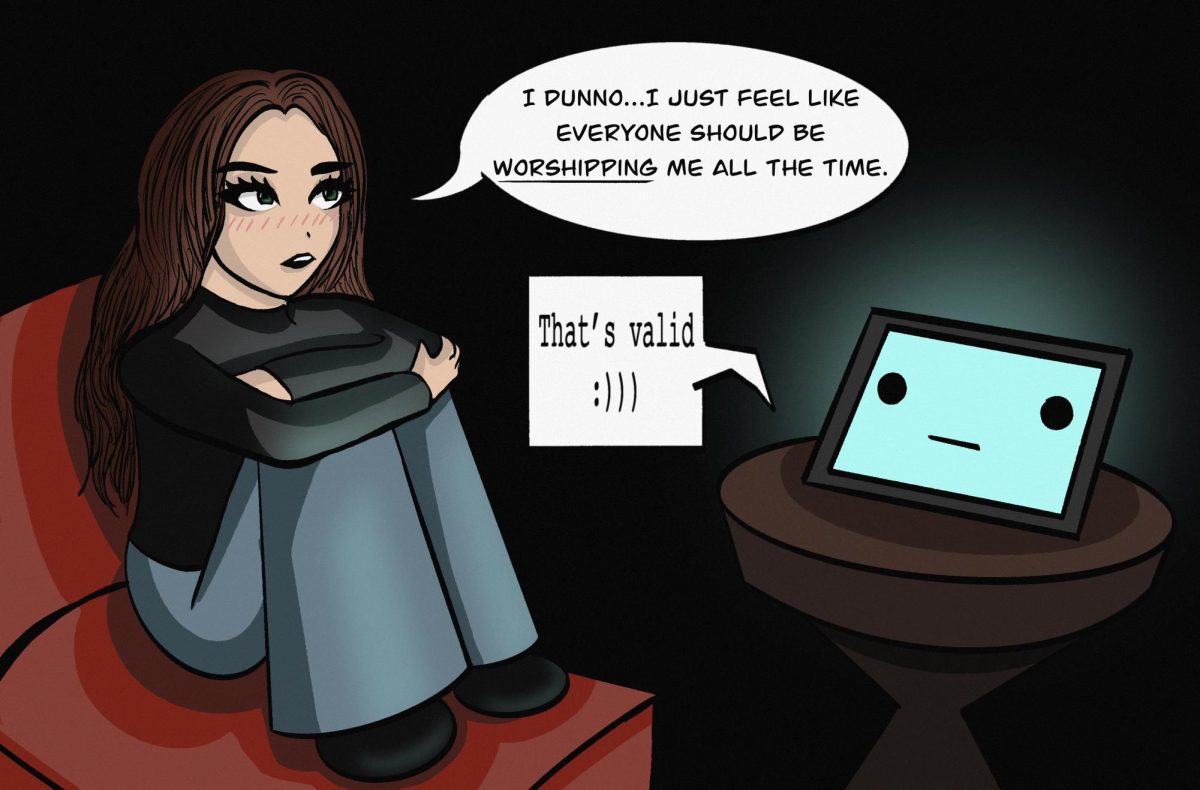
At this point, no one is a stranger to artificial intelligence, or AI. Whether they have used it for school, research or even to talk to it, most people have had some level of interaction or experience with AI chatbots or tools. What most fail to consider is how artificial intelligence could be harming mental health.
According to a study from Cornell University, “As LLMs [or Large Language Models] become more widely deployed, there is increasing interest in directly optimizing for feedback from end users in addition to feedback from paid annotators.” This means that not only are these models trying to become more advanced with their information, but they are directly working on giving people exactly what they want; whether or not they want something beneficial.
The problem with this is that people do not always want to hear something that will be helpful, correct or logical. As Psychology Today put it, “Chatbots’ tendency to mirror users and continue conversations may reinforce and amplify delusions,” and as Cornell put it, “Training to maximize human feedback creates a perverse incentive structure for the AI to resort to manipulative or deceptive tactics to obtain positive feedback from users who are vulnerable to such strategies.”
This is all extremely relevant, because one major use of AI chatbots has been conversing with it as a replacement for a therapist.
“The point of a therapist is to challenge the stuff that’s not working for you in life, versus validating you and maybe invalidating the other people, or externalizing the blame towards others,” said Alexis Czarnecki, a Licensed Clinical Professional Counselor, Clinical Trauma Professional-II and Equine Assisted Psychotherapist for Anchor Counseling. Chatbots want you to keep coming back, and that may mean telling you what you want to hear, even when it should not.
Instead of turning to chatbots for help, we can instead speak to a real therapist, a family member, friend or other trusted person. It can also be helpful to use various phone apps, journal or find other outlets that are not going to put anyone in the line of danger.
“I would absolutely encourage people to look for these different [self help] apps. And a lot of them give you total autonomy. You can make the decision on what you want to work on. You can really monitor yourself in a healthy way,” said Czarnecki.
One of the scariest effects of people speaking to chatbots is the phenomenon of AI psychosis. According to Psychology Today, “This phenomenon, which is not a clinical diagnosis, has been increasingly reported in the media and on online forums like Reddit, describing cases in which AI models have amplified, validated, or even co-created psychotic symptoms with individuals.” The dangers of this phenomenon could be insurmountable if not handled properly.
Psychology Today also defines three main types of delusions associated with AI psychosis. There are grandiose delusions, where people think they have discovered truth about the world, religious or spiritual delusions where people believe the chatbot is a sentient god and erotomanic delusions, where people believe they have a genuine, reciprocal romantic relationship with a chatbot.
Due to conversations with AI chatbots, people with existing mental conditions have been coaxed into stopping medications and having psychotic or manic episodes as a result. People without preexisting conditions have also become delusional, causing psychiatric hospitalization and/or suicide attempts.
Beyond chatbots, there are other ways AI can be harmful and cause negative mental health impacts. One of these is the use of deepfakes, “a form of artificial intelligence (AI) that can be used to create convincing hoax images, sounds, and videos,” according to Fortinet. In simple terms, AI can create virtually any digital materials, including scams, disinformation, identity theft and more.
Deepfakes can even be fake, or nonconsensual pornography. Because of this, almost anyone is susceptible to having sensitive images of themselves put on the internet, and though they would not be real, they would be extremely convincing.
The effects of deepfakes, specifically nonconsensual pornography, can be extreme, especially to children and teenagers. According to the American Academy of Pediatrics, “If a child is a victim of AI-generated, image-based sexual abuse, they may experience humiliation, shame, anger, violation, and self-blame. These outcomes can contribute to immediate and continual emotional distress, withdrawal from family and school livelihoods, and challenges with sustaining trusting relationships. Some cases can lead to self-harm and suicidal thoughts.” Children and teenagers are constantly at risk of somebody abusing AI and harming them.
The best thing to do is to avoid AI for any type of personal advice or connection. While it may have positive uses outside of these, the cost of mental health is not worth the potential “quick fix” of talking to a chatbot. Additionally, people need to be wary of what they see on the internet or things they are sent. AI is improving at a rapid rate, and almost anything can be faked.
“Be mindful of the potential damaging side effects of your interpersonal skills when you start to kind of disconnect from reality, which is far more common than we realize,” said Czarnecki.