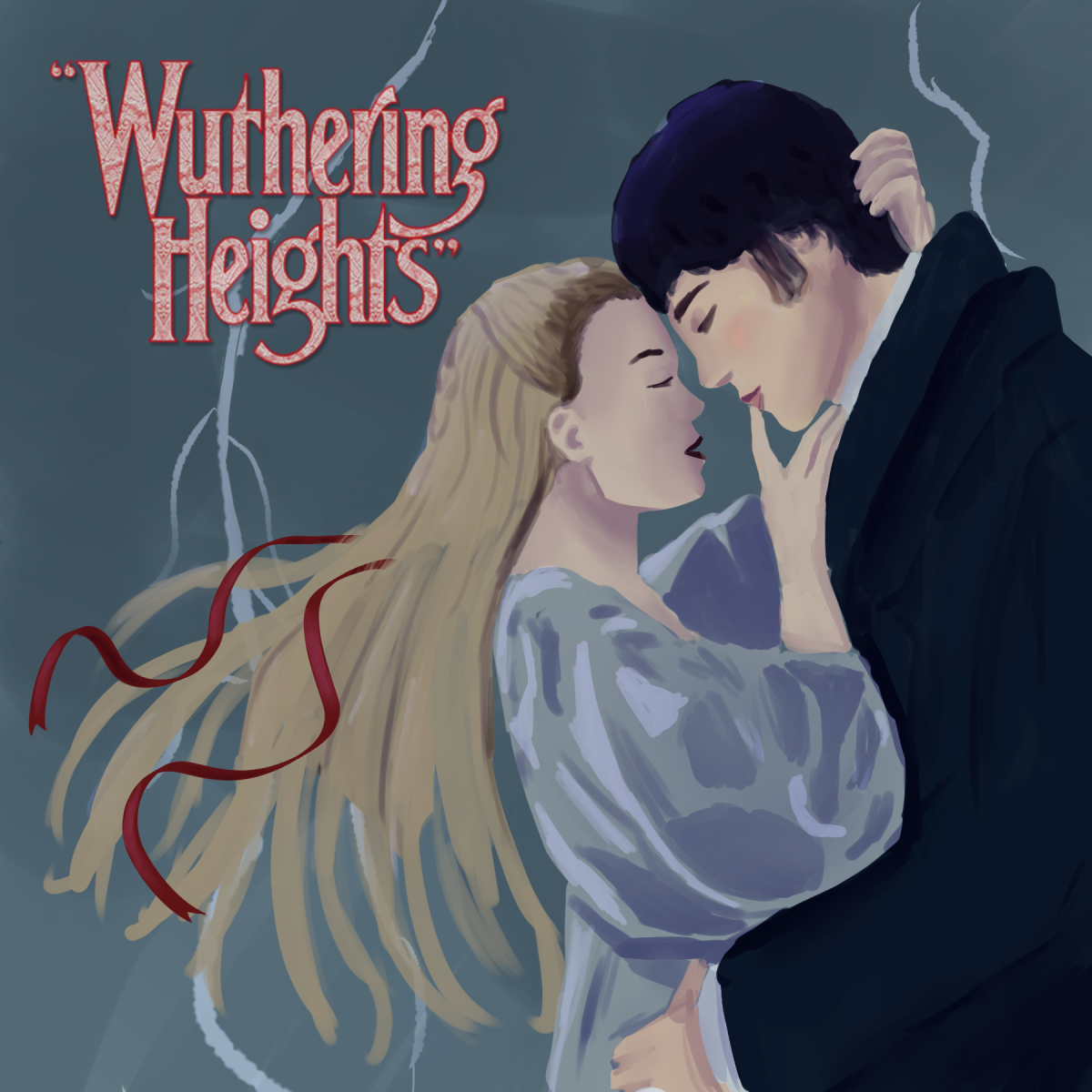
When adapting beloved classic novels into film, how far are filmmakers allowed to go? At what point do creative liberties cause an adapted movie to no longer embody the theme and soul of the original text, and is losing sight of that spirit even a big deal at all? That is the question that seems to be at the forefront of the discourse surrounding Emerald Fennell’s newest film, “‘Wuthering Heights,’” loosely based on the 1847 Emily Brontë novel of the same name — minus the additional quotation marks.
“Wuthering Heights” is a classic gothic that follows the lives of Catherine Earnshaw and Heathcliff, who reside at the estate of Wuthering Heights in the Yorkshire moors. The story is well-known for its dark tone and toxic romance. Margot Robbie and Jacob Elordi take on this daunting classic in Fennell’s new film.
I am not a firm believer in a strict, faithful-only requirement on adaptations, nor do I believe it essential to read a novel before you see its adapted film. However, I delved into the original world of “Wuthering Heights” recently, reading the classic novel to have a solid grasp of the story’s plot, theme and cultural significance. Thus, I believe I am qualified to specify that Brontë’s book, based in the late 1700s, does not feature outfits made of cellophane and latex, bedrooms with walls made to look like human skin — veins and moles included — nor a blonde Catherine snacking on palm-sized strawberries in a comically large sunhat.
It is easy to gather from the first few minutes of this film that the costuming and set design vary dramatically from the book. The film’s visual choices are like a merging of the styles of a surreal, moody Tim Burton and an exaggerated, bold Baz Luhrmann. Fennell makes it clear that this iteration of “Wuthering Heights” is a dark, fantastical dreamscape, which is a refreshing way to tackle the gothic tone of the novel. Classic gothic novels are characterized by eerie, melodramatic storylines with elements made to shock and disturb readers. Fennell’s film does not simply stick to the 1700s-type gothic elements of ghosts and brooding Yorkshire moors, no, “‘Wuthering Heights’” disturbs the audience with pure absurdity instead. The peculiar, campy and sultry production elements still deliver that angstiness and macabre, leaving viewers unsettled, just as the original novel does — but in a completely new and strange way. Alongside the visuals, Charli xcx’s anachronistic soundtrack aids in this abstract approach.
Though the film is a visual and auditory treat, the writing and ultimate messaging get blurry quickly. I can not speak about this film without addressing its greatest fault — casting a white man to play the racially ambiguous Heathcliff. In the novel, Heathcliff’s race is not clarified exactly, but the descriptions of his dark skin and black hair, as well as mentions of his unknown origins have keyed readers in for almost 200 years to believe Heathcliff is anything but white. Heathcliff’s race plays a significant role in the novel’s themes about race and class difference, which is the driving factor in keeping Catherine and Heathcliff apart and is a component of why Heathcliff is mistreated so harshly in his young life, which ends up majorly influencing him later on. The social complications the book focuses on are nearly nonexistent with a white Heathcliff.
It is hard to fit all of the frustrations about little discrepancies I have for this film in a short review, given there were so many poorly-decided deviations. Again, I am not an adaptation purist, but there are significant details that would have made this film much better were they included: namely, not completely omitting Hindley Earnshaw, Catherine’s older brother who physically and verbally abused Heathcliff, shaping him into the vengeful character he is known to be. And, like most other “Wuthering Heights” adaptations, this film also chooses to stop at Catherine’s death, which is only the halfway mark in the book. The novel’s second half is where the audience gets a full understanding of Heathcliff’s descent into madness and his straight-up villainy in the wake of his lover’s passing.
But at the end of the day, the way I see it, you can change almost anything about an original story in an adapted film and still have it hold up, at least in theory. The only thing that is essential is ensuring that the adaptation captures the intention of the original text. If I were to strip “Wuthering Heights” to its core and identify the most crucial parts of the story and messaging, I would emphasize that this is not a love story — controversial, I know. The most iconic and jarring thing about the novel is the utter detestability of Catherine and Heathcliff and the toxicity of their relationship. Anti-heroes if you squint, the two are not good people meant to be idolized, and the audience is not supposed to admire their twisted romance. In “Wuthering Heights,” Brontë portrays a relationship between two terrible people, made terrible by their traumatic childhoods and the barriers that keep them apart.
While Fennell’s film depicts some of the ways the two were cruel, co-dependent monsters, the two are not nearly as unlikeable as in the book. As viewers, we are made to feel sympathy for the pair and their doomed separation, especially when the film flashes between the compellingly heartwarming scene of the two as children being innocently in love and the frame of Heathcliff sobbing against Catherine’s corpse. That inconsistency in messaging makes this adaptation frustrating.
“‘Wuthering Heights’” is what you make it. If you are watching it as a standalone film, the striking visuals and plot make for great entertainment. If you want to draw connections between this film and the book, and hope to see the theme of the novel shine through, you will be disappointed. Determined to market itself to a wider audience, “‘Wuthering Heights’” disregards the heart of the source material and dilutes its thematic poignancy, making for an adequate film with an icky aftertaste.