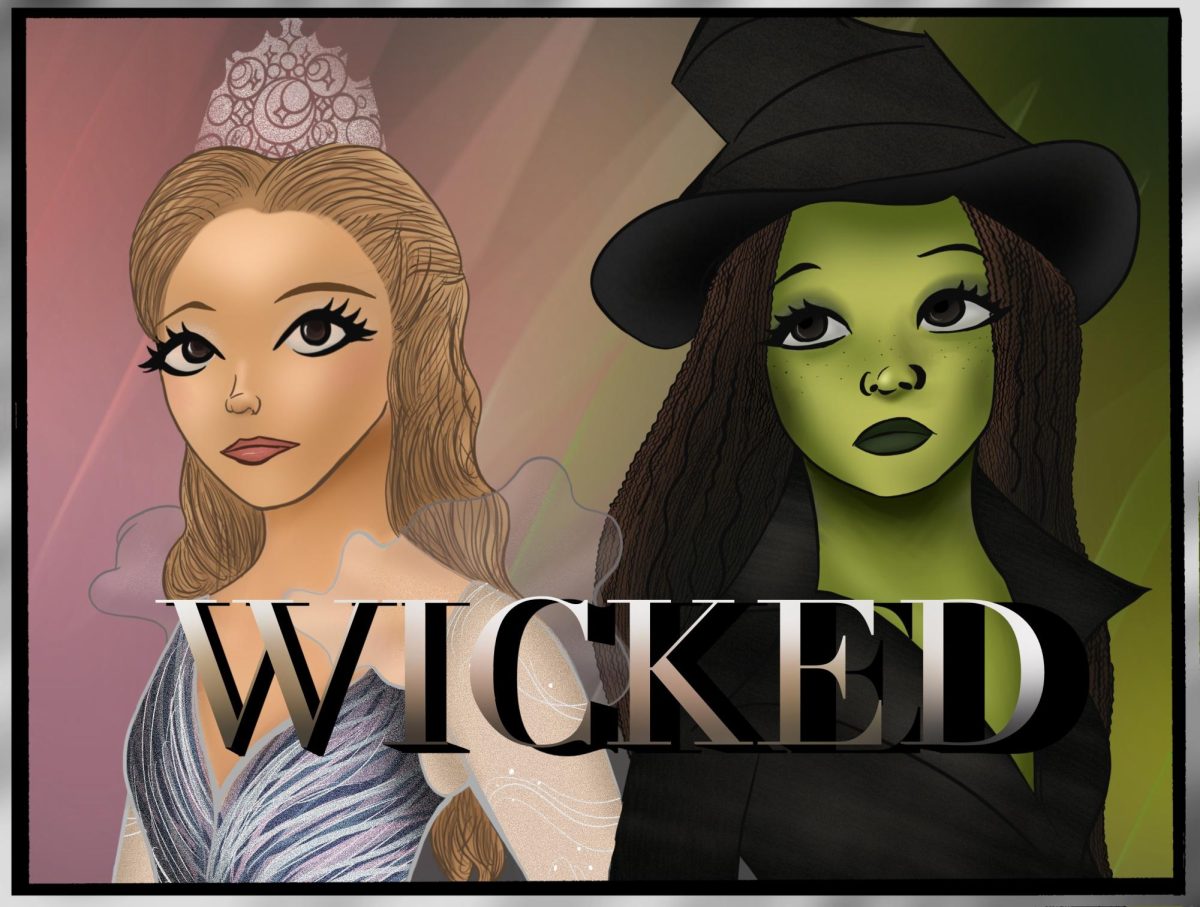
“Wicked: For Good,” the long awaited sequel to “Wicked,” released to theaters on Nov. 21. “Wicked” has already gotten a lot of attention, especially towards actresses Cynthia Erivo, who played Elphaba, and Ariana Grande, who played Glinda. With the amount of attention the two actresses received on a multitude of somewhat scandalous interviews, viewers were finally able to see if part two was worth all of its popularity.
Unlike the first movie, the pacing in “Wicked: For Good” was too slow, which made certain scenes feel boring rather than impactful. Additionally, the new songs were way too long, which caused the songs to be less memorable than the first movie. Oftentimes, certain songs would have been better off without adding a key change, dragging on extra repeated reprises and new characters brought in to sing their own versions. “Wicked: For Good” could have benefited from more dialogue instead, which would further help explain the numerous plot twists and connections to “The Wizard of Oz.” Without knowing the context of the original musical, these scenes can be confusing and difficult to understand. Overall, the sequel was more of a wrap up focused on trying to make everything from the first movie make sense rather than adding more to the story.
One of the best things about “Wicked: For Good” was the amount of contrast the film implemented with Elphaba and Glinda. Elphaba is free, she is hated but she is the protagonist, she speaks up for herself and she is strong by herself. Glinda appears to be free, she is loved but she is more of an antagonist, she does not speak up for herself and she is given her power and strength which can be taken away. Other details of symbolism can be seen with Elphaba’s broomstick, which is seen as “ugly” but is stable and able to move around freely. Glinda’s bubble is seen as “beautiful” but it is artificial and cannot be moved by itself. Overall, there was a good mix of truly evil characters, such as Madame Morrible, and characters who were in the middle, like Glinda.
Key themes in the movie were identity, like how Dorothy and Glinda, both good characters, see Elphaba in entirely different ways mainly because of the propaganda, another topic the movie heavily revolved around. The pushing of specific agendas on characters, like the Wicked Witch of the West or Glinda the Good, controlling mass crowds and making people believe anything significantly defined the plot of “Wicked: For Good.” The movie also dives deeper into truth versus fact, where the movie describes truth as the thing everyone agrees on versus fact as being something actually real, regardless of what people think.
Overall, the purpose of “Wicked: For Good” was tying up the loose ends of the first movie, which was accomplished just fine. “Wicked: For Good” was not as good as “Wicked” because it was not as memorable, as it lacked the charm, humor, originality and delivery of storytelling in the first movie. “Wicked: For Good” is still a great movie, but “Wicked” is ten times better with the songs, storytelling and dialogue—minus the made up words.